
When technicians lose air pressure in the middle of a demanding job, productivity drops fast. Whether the task involves tire service, heavy equipment repair, utility maintenance, or field welding support, compressed air often determines how quickly crews can complete work and move to the next service call. That is why the debate between rotary screw and piston air compressors matters far more today than it did a decade ago.
For years, reciprocating piston compressors were common on service trucks because they were familiar and inexpensive. But fleet demands have changed. Modern service vehicles now carry more tools, support more mobile operations, and operate under tighter uptime expectations. Fleets are also under pressure to reduce maintenance costs, improve fuel economy, and maximize payload capacity.
As a result, rotary screw air compressors have become the preferred choice for many mechanics, utility operators, municipalities, tire service providers, construction fleets, and mobile repair technicians.
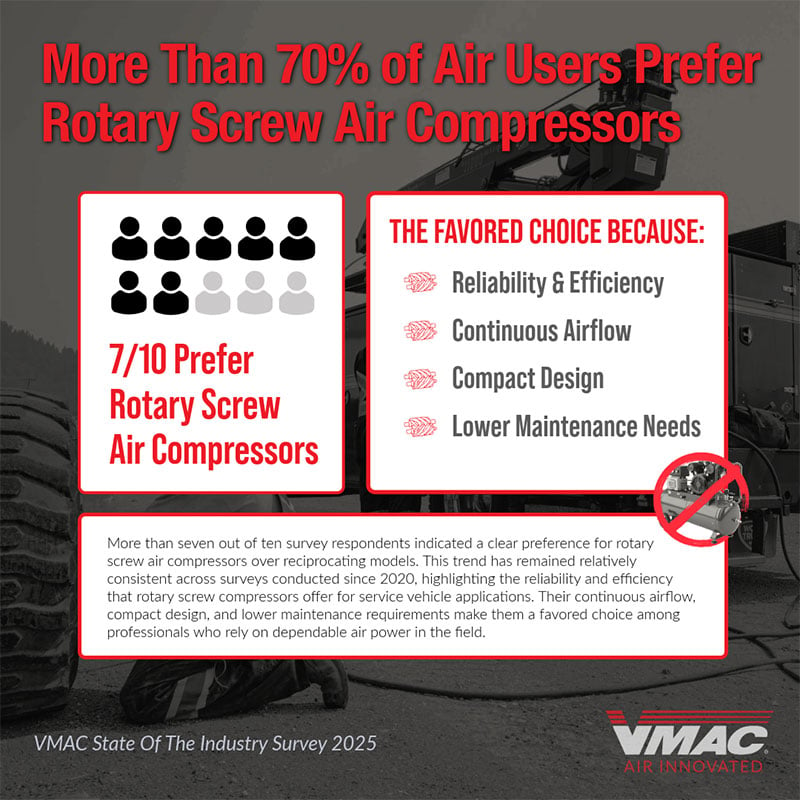
According to the 2025 VMAC State of the Mobile Compressed Air Industry Report, approximately 75% of respondents prefer rotary screw air compressors over reciprocating compressors for mobile applications. That shift reflects how field service work has evolved toward continuous-duty performance, reliability, and operational efficiency.
What Is the Difference Between Rotary Screw and Piston Air Compressors?
Both compressor types generate compressed air, but they operate very differently.
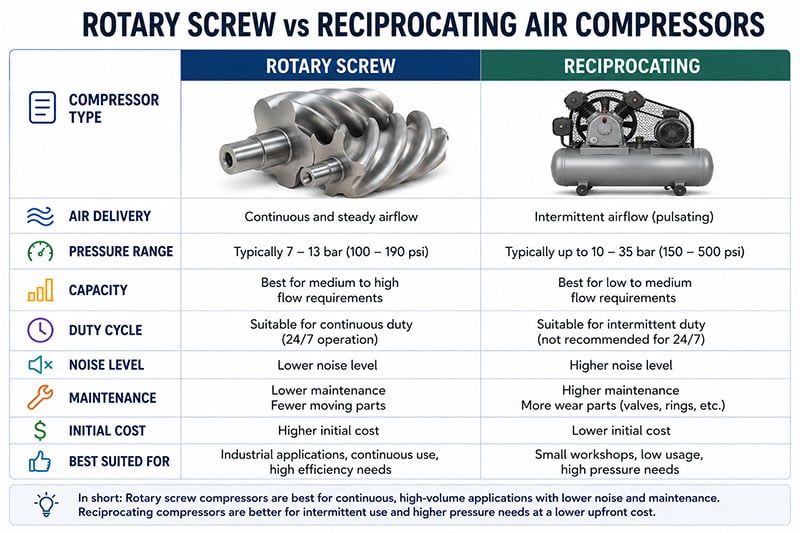
A piston compressor, also called a reciprocating compressor, uses pistons moving inside cylinders to compress air in cycles. Air is compressed during each piston stroke and stored in a tank for intermittent use.
A rotary screw air compressor uses two interlocking helical rotors that continuously compress air as they rotate. Instead of pulsing air in cycles, rotary screw systems deliver a smooth and uninterrupted airflow.
That distinction has major implications for service truck applications.
Piston compressors are generally designed for intermittent operation. Rotary screw compressors are engineered for continuous-duty performance. For technicians operating impact wrenches, grinders, pavement breakers, or jackhammers throughout the workday, continuous airflow matters.
Why Continuous Duty Cycle Matters in Mobile Service Applications
One of the biggest operational differences between these compressor styles is duty cycle.
 Duty cycle refers to the percentage of time a compressor can operate safely within a given period.
Many piston compressors require cool-down periods after prolonged use. Running beyond recommended limits can lead to overheating, excessive wear, or premature failure.
Rotary screw systems are designed for 100% duty cycle operation. That means technicians can run tools continuously without stopping the compressor to recover.
For mobile mechanics and service fleets, that matters because downtime costs money.
Imagine a tire service truck working roadside repairs on commercial vehicles. If airflow drops or the compressor overheats during operation, technicians lose valuable time waiting for pressure recovery. That delay impacts both customer satisfaction and daily service capacity. It can also impact operator safety as they wait on the side of the road for the air compressor to build compressed air.
Rotary screw compressors eliminate much of that interruption.
As WorkTruck Magazine states, “Rotary screw air compressors’ lengthy lifespan is a huge advantage over reciprocating air compressors.”
Maintenance Differences Between Rotary Screw and Piston Compressors
Maintenance requirements represent another major differentiator.
Piston compressors contain many moving parts subject to repeated mechanical stress including pistons, rings, connecting rods, valves, and crankshafts.
Rotary screw compressors operate with fewer reciprocating components and smoother rotational motion. That design often reduces vibration and mechanical wear.
As a result, rotary screw systems frequently require fewer service interruptions, less maintenance downtime, reduced vibration-related wear, and improved long-term reliability.
Atlas Copco states on their website that rotary screw air compressors are “known for its smooth and consistent air flow”, are generally more efficient and easier to maintain. This sentiment is mirrored by Chicago Pneumatic, stating that “rotary screw compressors require less frequent maintenance”.
Why Rotary Screw Compressors Are Better for Harsh Work Environments
Field service work is rarely clean or controlled.
Technicians work in construction zones, mining operations, forestry applications, roadside environments, utility restoration sites, and agricultural operations.
These environments place heavy demands on equipment.
Rotary screw compressors are commonly selected for these applications because they can sustain airflow under prolonged workloads and variable environmental conditions. One example was a recent job completed by the BC Discovery Centre using VMAC’s new gas-driven air compressor, the G90 with FlexDrive AMS, which enabled staff and volunteers to complete a railway upgrade and replacement at their 100 acre location earlier this spring. Read the full story here: https://www.vmacair.com/blog/vmac-supporting-railway-restoration-at-the-bc-forest-discovery-centre-with-mobile-compressed-air

Air Delivery Consistency Improves Tool Performance
Compressed air quality and consistency directly affect tool operation.
Rotary screw systems provide smoother airflow delivery. That helps air-powered tools operate more consistently under load.
For technicians, this means improved productivity, more predictable tool behavior, less waiting, and faster completion times.
Fuel Efficiency and Engine Load
Vehicle-mounted compressors also affect fuel usage.
Heavier systems and inefficient compressor operation increase strain on vehicle drivetrains and engines.
Modern rotary screw systems are often engineered with compact packaging and efficient power transfer systems that help reduce unnecessary energy consumption.
Choosing the Right Compressor for Different Industries
The ideal compressor depends heavily on application demands.
 Rotary Screw Compressors Are Often Best For:
-
mobile mechanics
-
tire service fleets
-
utility service trucks
-
construction support vehicles
-
mining repair operations
-
municipalities
-
heavy-duty field service
Piston Compressors May Still Fit:
-
light intermittent use
-
hobby applications
-
small shop environments
-
occasional low-demand air usage
How VMAC Rotary Screw Systems Support Fleet Productivity
VMAC designs and manufactures mobile compressed air systems specifically for vehicle-mounted applications.
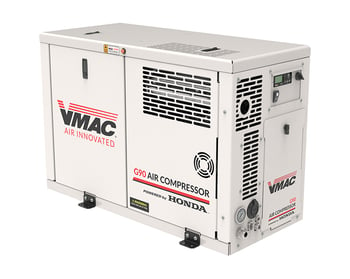 Systems such as the VMAC G30, G90, and DTM70 are engineered to provide continuous-duty rotary screw performance for mobile applications. The UNDERHOOD® air compressors designed and manufactured by VMAC use rotary screw technology designed to run at 100% duty cycle without stopping or overheating, so operators don’t have to wait for their air compressor.
Many fleets also prefer integrated systems because they simplify vehicle upfitting and improve overall service body organization.
Final Thoughts
Piston compressors still have a place in some low-demand applications. But the realities of modern fleet operations increasingly favor rotary screw technology.
Service fleets today need continuous airflow, reliable performance, compact installations, reduced maintenance, lower downtime, and better payload efficiency.
Rotary screw air compressors address those needs more effectively for many commercial mobile applications.
